Spark Fundamentals Interview Questions for Data Engineers
Apache Spark is one of the most important technologies in Data Engineering interviews.
Before learning advanced topics like Spark optimization, joins, AQE, data skew, and architecture, every candidate should first build strong Spark fundamentals.
Many candidates directly jump into advanced Spark concepts without understanding the basics properly.
That creates problems during interviews.
For example, an interviewer may ask:
What is Lazy Evaluation in Spark?
A candidate may answer:
Spark does not execute immediately.
But then the interviewer may ask:
- Why does Spark use Lazy Evaluation?
- How is DAG created?
- What triggers execution?
- How does Lazy Evaluation help optimization?
- Difference between Transformation and Action?
This is where memorized answers fail.
In this blog, we will cover the most important Spark fundamentals interview questions for Data Engineers.
The goal is not only to list questions, but to help you understand:
- What interviewers are testing
- How to approach each question
- What related topics you should prepare
- Which concepts are connected together
Why Spark Fundamentals Matter
Spark fundamentals are the foundation of every Spark interview.
Whether you are a fresher or an experienced Data Engineer, interviewers expect you to understand how Spark processes data.
Without fundamentals, it becomes difficult to understand:
- Spark Architecture
- Jobs, Stages, and Tasks
- Shuffle
- Optimization
- Data Skew
- Spark UI
- Memory Issues
- Performance Tuning
For example, if you do not understand Transformations and Actions, Lazy Evaluation will not make sense.
If Lazy Evaluation is unclear, DAG will be confusing.
If DAG is unclear, Jobs and Stages will become difficult.
That is why Spark fundamentals should be prepared in the correct order.
How to Prepare Spark Fundamental Questions
Do not prepare Spark fundamentals like definitions.
Prepare each concept using this structure:
What is the concept?
        ↓
Why does Spark need it?
        ↓
How does it work internally?
        ↓
Where is it used in real projects?
        ↓
What follow-up questions can come?
This approach helps you answer both basic and follow-up questions confidently.
What is Apache Spark?
Apache Spark is a distributed data processing engine used to process large-scale data across multiple machines.
Spark is commonly used for:
- Batch processing
- Streaming processing
- ETL pipelines
- Data lake transformations
- Machine learning workloads
- Large-scale analytics
In Data Engineering, Spark is mostly used to read, transform, process, and write large volumes of data.
What Interviewer is Testing
The interviewer wants to check whether you understand:
- Why Spark is used
- What problem Spark solves
- How Spark is different from normal Python or SQL processing
How to Approach This Question
Do not only say:
Spark is a big data processing framework.
Instead explain:
Spark helps process large data by distributing work across multiple machines. It breaks data into partitions and processes them in parallel using executors.
Why Spark is Used in Data Engineering
Spark is used because many real-world datasets are too large to process on a single machine.
Example:
Suppose a company receives:
- 500 GB sales data daily
- 200 million customer events
- Multiple source files from different systems
Processing this using normal Python or Pandas may not be practical.
Spark helps by:
- Distributing data
- Processing partitions in parallel
- Handling failures
- Optimizing execution
- Scaling across clusters
What Interviewer is Testing
The interviewer wants to know whether you understand the practical need for distributed processing.
Related Topics to Prepare
- Distributed Computing
- Partitioning
- Parallel Processing
- Executors
- Cluster Manager
Spark vs Hadoop MapReduce
Before Spark, Hadoop MapReduce was widely used for big data processing.
MapReduce had some limitations:
- Slow disk-based processing
- Complex programming model
- Poor performance for iterative workloads
- Multiple disk reads and writes
Spark improved this by introducing:
- In-memory processing
- DAG-based execution
- Easier APIs
- Faster iterative processing
- Support for batch, streaming, SQL, and ML workloads
Common Interview Question
Why is Spark faster than Hadoop MapReduce?
How to Approach
Explain that Spark avoids unnecessary disk writes by keeping intermediate data in memory where possible.
Also mention that Spark uses DAG optimization to improve execution.
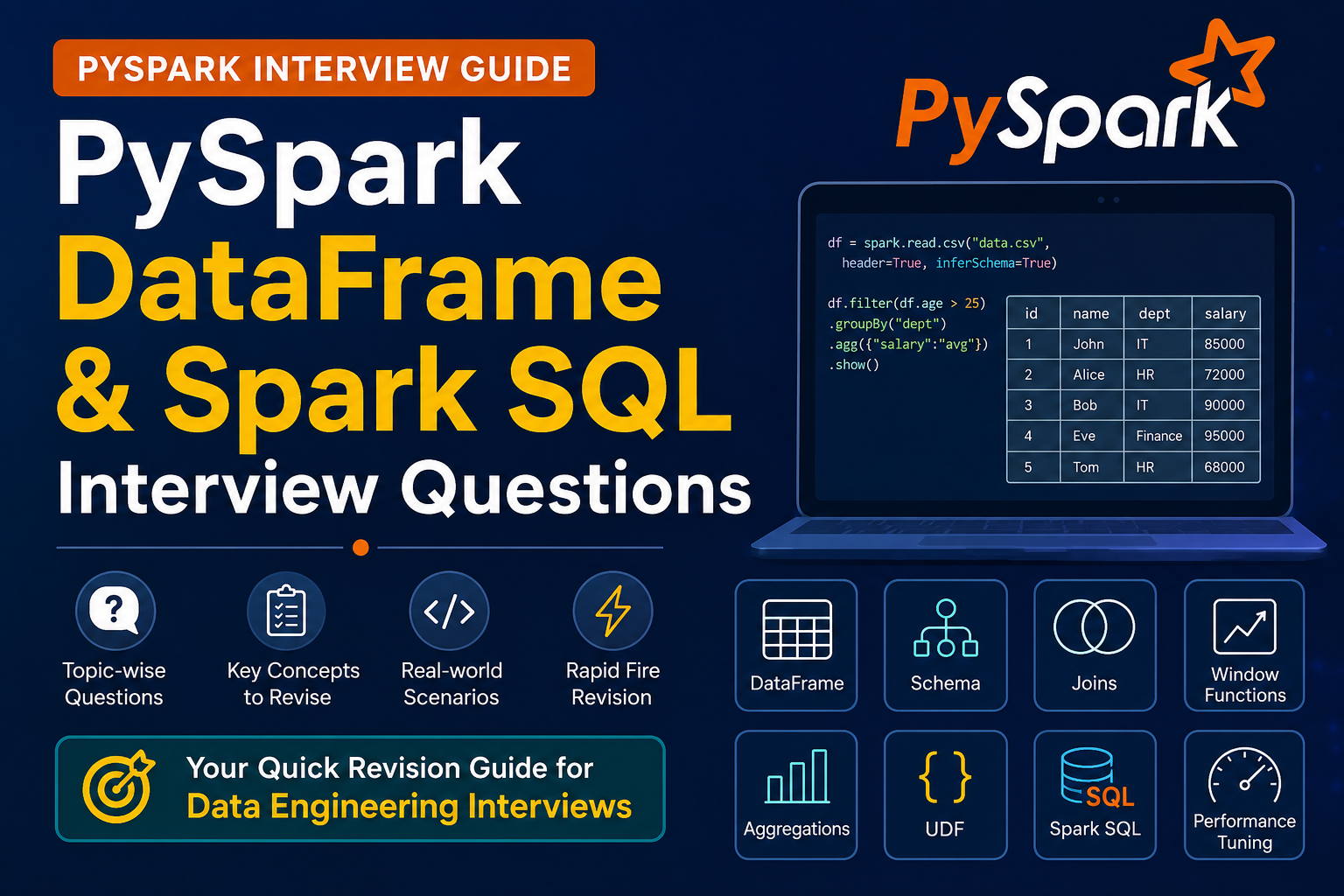
What is PySpark?
PySpark is the Python API for Apache Spark.
It allows developers to write Spark applications using Python.
Example:
df = spark.read.csv("sales.csv", header=True)

df.filter(df.amount > 1000).show()
PySpark is widely used by Data Engineers because Python is simple and popular in data projects.
What Interviewer is Testing
The interviewer wants to check whether you understand that PySpark is not a separate engine.
PySpark is simply a Python interface to Spark.
Related Topics to Prepare
- SparkSession
- DataFrame API
- Spark SQL
- Python vs Scala Spark
What is SparkSession?
SparkSession is the entry point for working with Spark DataFrames and Spark SQL.
Example:
from pyspark.sql import SparkSession

spark = SparkSession.builder \
    .appName("SalesPipeline") \
    .getOrCreate()
In modern Spark applications, SparkSession is used to:
- Read data
- Create DataFrames
- Run SQL queries
- Access SparkContext
- Configure Spark application
What Interviewer is Testing
The interviewer wants to know whether you understand how a Spark application starts.
Common Follow-Up Topics
- SparkSession vs SparkContext
- Can we create multiple SparkSessions?
- What is appName?
- What is getOrCreate()?
What is SparkContext?
SparkContext is the connection between your Spark application and the Spark cluster.
It is responsible for:
- Communicating with the cluster manager
- Creating RDDs
- Managing execution
- Coordinating jobs
Before SparkSession became common, SparkContext was the main entry point.
Today, SparkSession internally provides access to SparkContext.
Example:
sc = spark.sparkContextWhat Interviewer is Testing
The interviewer wants to know whether you understand the older and lower-level Spark entry point.
SparkSession vs SparkContext
| SparkSession | SparkContext |
|---|---|
| Modern entry point | Lower-level entry point |
| Used for DataFrames and SQL | Used mainly for RDDs |
| Introduced in Spark 2.x | Available from early Spark versions |
| Preferred in PySpark projects | Used internally by SparkSession |
How to Approach
Explain that SparkSession is commonly used in modern PySpark applications, while SparkContext is the lower-level object used to communicate with the Spark cluster.
What are Transformations in Spark?
Transformations are operations that create a new DataFrame or RDD from an existing one.
Examples:
df2 = df.filter(df.city == "Bangalore")

df3 = df.select("customer_id", "city")
Transformations do not execute immediately.
They are lazy.
Common Transformation Examples
- select()
- filter()
- withColumn()
- groupBy()
- join()
- distinct()
- orderBy()
What Interviewer is Testing
The interviewer wants to check whether you understand Spark's lazy execution model.
What are Actions in Spark?
Actions trigger actual execution in Spark.
Examples:
df.show()

df.count()

df.collect()

df.write.parquet("output/path")
Until an action is called, Spark only builds the execution plan.
Common Actions
- show()
- count()
- collect()
- take()
- first()
- write()
- save()
What Interviewer is Testing
The interviewer wants to know whether you understand what actually starts Spark execution.
Transformations vs Actions
| Transformations | Actions |
|---|---|
| Lazy | Trigger execution |
| Create new DataFrame/RDD | Return result or write output |
| Build execution plan | Execute the plan |
| Example: filter() | Example: count() |
| Example: select() | Example: show() |
Simple Example
df = spark.read.csv("sales.csv", header=True)

filtered_df = df.filter(df.amount > 1000)

selected_df = filtered_df.select("customer_id", "amount")
No execution happens yet.
Execution starts only when:
selected_df.show()Common Interview Follow-Up
Why does Spark separate transformations and actions?
Answer approach:
This allows Spark to optimize the complete execution plan before running the job.
What is Lazy Evaluation in Spark?
Lazy Evaluation means Spark does not execute transformations immediately.
Spark waits until an action is triggered.
During this waiting period, Spark builds an execution plan.
Example:
df = spark.read.csv("customers.csv", header=True)

df1 = df.filter(df.city == "Pune")

df2 = df1.select("customer_id", "city")
Spark does not execute these transformations immediately.
When we run:
df2.show()Spark executes the complete plan.
Why Lazy Evaluation is Important
Lazy Evaluation helps Spark:
- Optimize execution
- Avoid unnecessary computation
- Combine transformations
- Reduce data movement
- Improve performance
What Interviewer is Testing
The interviewer wants to check whether you understand Spark execution internally.
Related Topics to Prepare
- DAG
- Transformations
- Actions
- Catalyst Optimizer
- Execution Plan
What is DAG in Spark?
DAG stands for Directed Acyclic Graph.
In Spark, DAG represents the complete flow of transformations.
Example:
Read Data
    ↓
Filter Rows
    ↓
Select Columns
    ↓
Group By
    ↓
Write Output
Spark creates a DAG before execution.
Why DAG is Important
Spark uses DAG for:
- Execution planning
- Optimization
- Stage creation
- Fault tolerance
- Task scheduling
What Interviewer is Testing
The interviewer wants to know whether you understand how Spark organizes transformations internally.
What is Lineage in Spark?
Lineage means Spark remembers how a DataFrame or RDD was created.
It keeps track of the sequence of transformations.
Example:
Raw Data
   ↓
Filter
   ↓
Select
   ↓
Aggregate
If any partition is lost, Spark can recompute it using lineage.
Why Lineage is Important
Lineage helps Spark achieve fault tolerance.
If a node fails, Spark does not need to restart the full job from the beginning.
It can recompute only the lost partition.
Related Topics
- Fault Tolerance
- DAG
- RDD
- Partition Recovery
What is Fault Tolerance in Spark?
Fault tolerance means Spark can recover from failures.
Failures can happen due to:
- Executor failure
- Worker node failure
- Network issue
- Lost partition
- Task failure
Spark handles failures using:
- Lineage
- Task retry
- Partition recomputation
- Cluster manager support
Example
If one executor fails while processing a partition, Spark can re-run that task on another executor.
What Interviewer is Testing
The interviewer wants to know whether you understand how Spark handles failure in distributed systems.
What is Partitioning in Spark?
Partitioning means dividing data into smaller chunks.
Spark processes data partition by partition.
Example:
Large Dataset
      ↓
Partition 1
Partition 2
Partition 3
Partition 4
Each partition can be processed by a separate task.
Why Partitioning Matters
Partitioning affects:
- Parallelism
- Performance
- Shuffle
- File size
- Resource utilization
Good partitioning improves performance.
Bad partitioning can make Spark jobs slow.
Common Follow-Up Questions
- How many partitions should a DataFrame have?
- What happens if partitions are too small?
- What happens if partitions are too large?
What is Parallel Processing in Spark?
Parallel processing means Spark processes multiple partitions at the same time.
Example:
If a dataset has 100 partitions, Spark can process many of those partitions in parallel depending on available executors and cores.
This is one of the main reasons Spark is fast.
What Interviewer is Testing
The interviewer wants to check whether you understand how Spark distributes workload across the cluster.
What are Narrow Transformations?
Narrow transformations are transformations where each output partition depends on only one input partition.
Examples:
df.filter(df.amount > 1000)

df.select("customer_id", "amount")
Common narrow transformations:
- filter()
- select()
- map()
- withColumn()
Narrow transformations do not require shuffle.
Why Narrow Transformations are Efficient
They are faster because data does not need to move across partitions.
What are Wide Transformations?
Wide transformations are transformations where output partitions depend on multiple input partitions.
Examples:
df.groupBy("region").count()

df.join(other_df, "customer_id")
Common wide transformations:
- groupBy()
- join()
- distinct()
- orderBy()
- repartition()
Wide transformations usually cause shuffle.
Why Wide Transformations are Expensive
They involve:
- Data movement
- Network I/O
- Disk I/O
- Serialization
- Stage boundaries
Narrow vs Wide Transformations
| Narrow Transformation | Wide Transformation |
|---|---|
| No shuffle | Causes shuffle |
| Faster | Expensive |
| One partition dependency | Multiple partition dependencies |
| Example: filter | Example: groupBy |
| Example: select | Example: join |
Interview Tip
Whenever you hear groupBy, join, distinct, or orderBy, think about shuffle.
What is Shuffle in Spark?
Shuffle means moving data across partitions or executors.
Shuffle happens when Spark needs to reorganize data.
Common operations causing shuffle:
groupBy()
join()
distinct()
orderBy()
repartition()
Why Shuffle is Expensive
Shuffle is expensive because it involves:
- Network transfer
- Disk write
- Disk read
- Serialization
- Memory pressure
What Interviewer is Testing
Shuffle is one of the most important Spark concepts.
If you understand shuffle deeply, Spark optimization becomes much easier.
What is Serialization in Spark?
Serialization means converting objects into bytes so they can be transferred across the network or stored.
Spark uses serialization when:
- Sending data between executors
- Moving data during shuffle
- Caching data
- Writing data
Poor serialization can impact performance.
Related Topics
- Kryo Serialization
- Java Serialization
- Shuffle
- Network Transfer
What are Shared Variables in Spark?
Shared variables allow data to be shared across tasks.
Spark provides two main types:
- Broadcast Variables
- Accumulators
These are useful in distributed processing.
What are Broadcast Variables?
Broadcast variables are used to send read-only data to all executors.
Example use case:
A small lookup table is needed by all tasks.
Instead of sending it repeatedly, Spark broadcasts it once.
Common Use Case
Broadcast variables are often used in broadcast joins.
What are Accumulators?
Accumulators are variables used for aggregating information across tasks.
Example use cases:
- Counting bad records
- Counting rejected rows
- Tracking error records
They are mainly used for monitoring and debugging.
Spark Fundamentals Interview Questions
Here are the most important Spark fundamentals questions you should prepare.
-
What is Apache Spark?
-
Why is Spark used in Data Engineering?
-
Why is Spark faster than Hadoop MapReduce?
-
What is PySpark?
-
What is SparkSession?
-
What is SparkContext?
-
Difference between SparkSession and SparkContext?
-
What are Transformations?
-
What are Actions?
-
Difference between Transformations and Actions?
-
What is Lazy Evaluation?
-
Why does Spark use Lazy Evaluation?
-
What is DAG in Spark?
-
Why is DAG important?
-
What is Lineage in Spark?
-
How does Lineage help in fault tolerance?
-
What is Fault Tolerance?
-
What is Partitioning?
-
Why are partitions important?
-
What is Parallel Processing?
-
What are Narrow Transformations?
-
What are Wide Transformations?
-
Difference between Narrow and Wide Transformations?
-
What is Shuffle?
-
Why is Shuffle expensive?
-
Which operations cause Shuffle?
-
What is Serialization?
-
What are Shared Variables?
-
What are Broadcast Variables?
-
What are Accumulators?
Scenario-Based Fundamental Questions
These questions test whether you understand fundamentals practically.
-
You applied multiple filters and selects, but Spark did not execute anything. Why?
-
A Spark job starts only after calling
show(). Why? -
A
groupBy()operation suddenly makes the job slow. What could be the reason? -
One partition is taking longer than others. What concept is involved?
-
An executor fails during processing. How can Spark recover?
-
A job has too much shuffle. Which operations would you check?
-
A candidate uses
collect()on a huge dataset. What can go wrong? -
A DataFrame has too few partitions. What impact can it have?
-
A DataFrame has too many partitions. What impact can it have?
-
Why should you understand DAG before learning Spark optimization?
Quick Revision Cheat Sheet
| Concept | Meaning |
|---|---|
| Spark | Distributed data processing engine |
| PySpark | Python API for Spark |
| SparkSession | Entry point for DataFrame and SQL |
| SparkContext | Connection to Spark cluster |
| Transformation | Lazy operation |
| Action | Triggers execution |
| Lazy Evaluation | Delayed execution until action |
| DAG | Execution flow graph |
| Lineage | Transformation history |
| Fault Tolerance | Ability to recover from failures |
| Partition | Chunk of data |
| Narrow Transformation | No shuffle |
| Wide Transformation | Causes shuffle |
| Shuffle | Data movement across executors |
| Serialization | Object conversion into bytes |
| Broadcast Variable | Read-only shared data |
| Accumulator | Shared counter for aggregation |
Conclusion
Spark fundamentals are the base of every PySpark and Data Engineering interview.
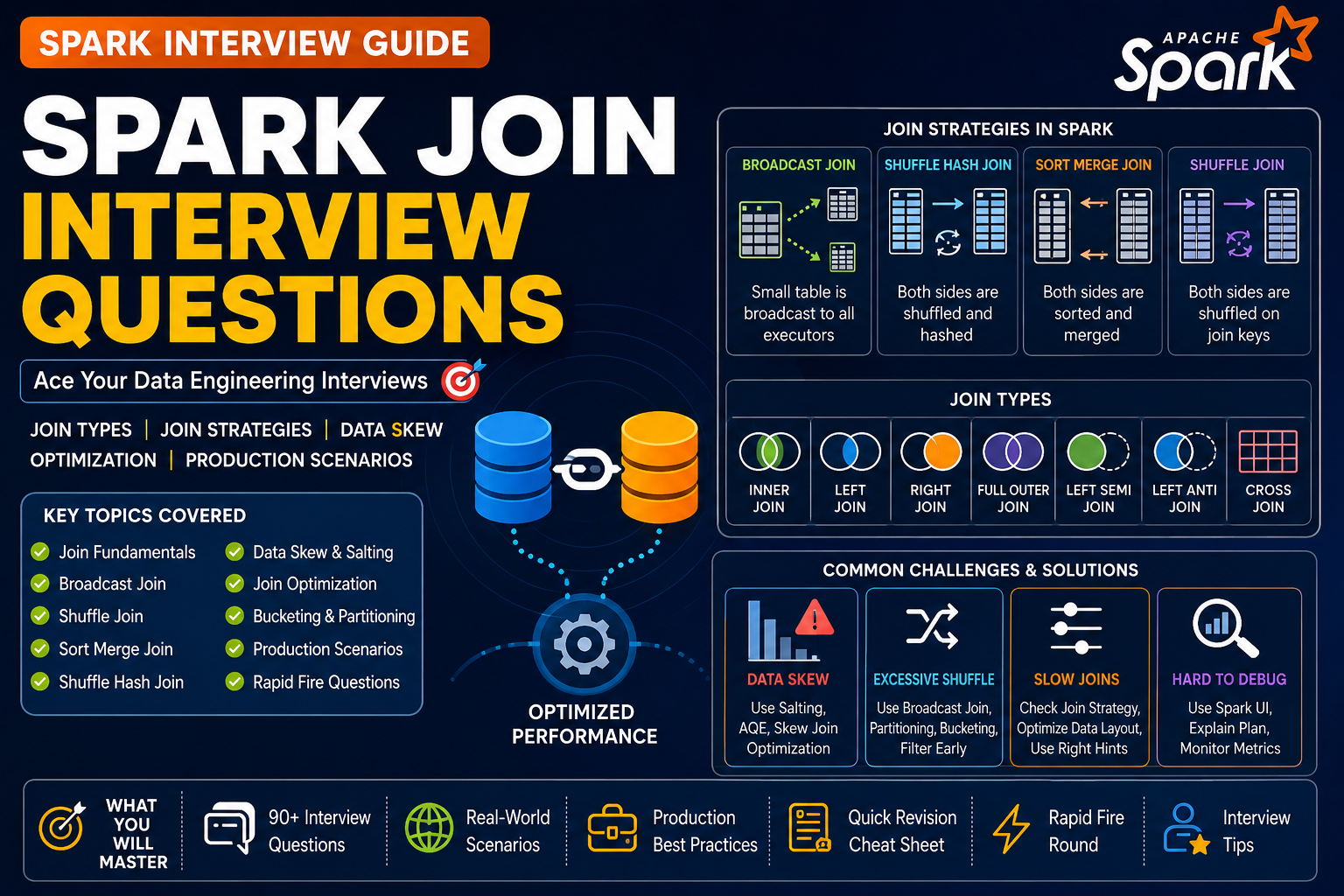
If you understand fundamentals clearly, advanced topics like Spark Architecture, Joins, Optimization, Data Skew, AQE, and Spark UI become much easier.
Spend enough time on these concepts before moving to advanced topics.
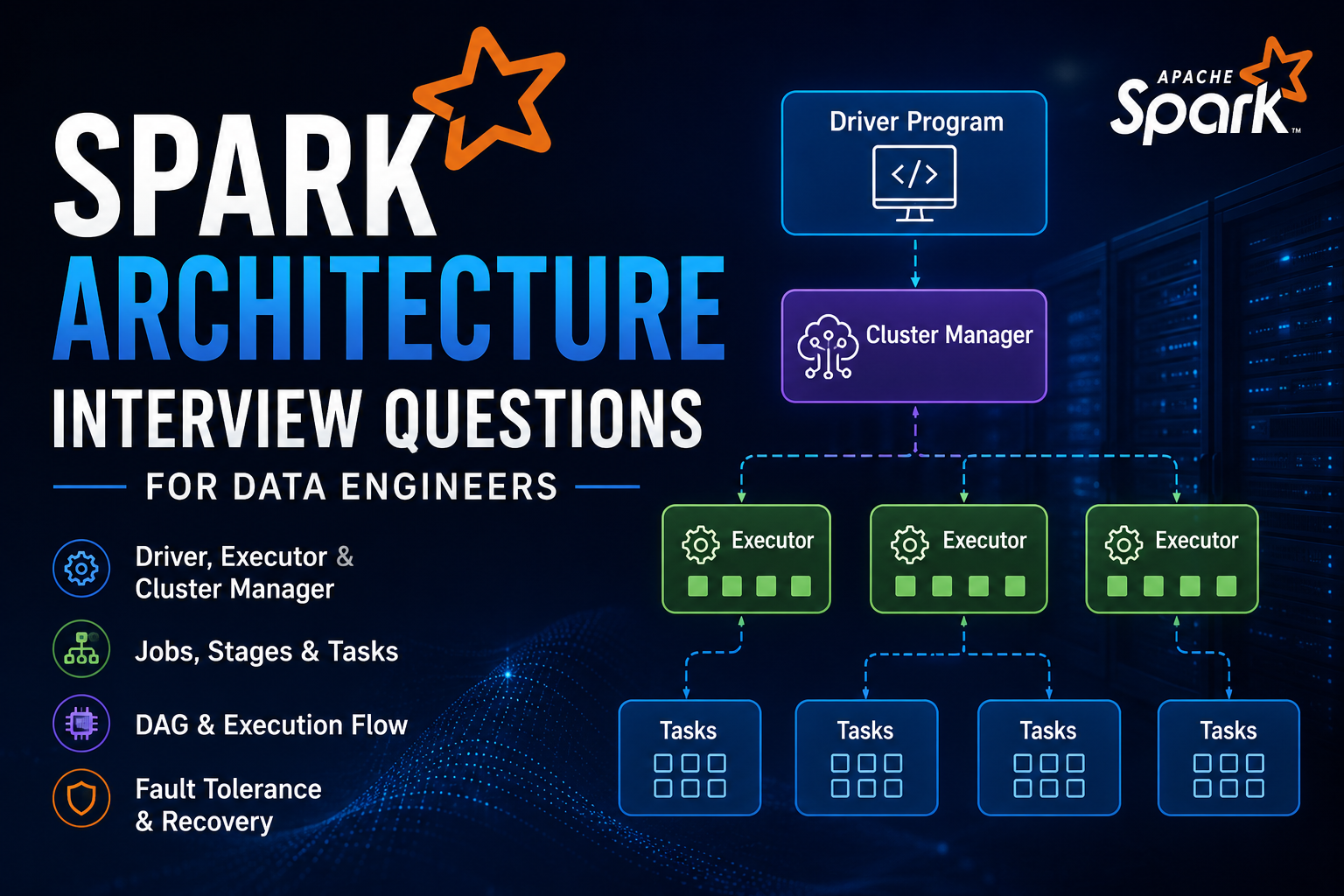
In the next article of this series, we will go deeper into Spark Architecture Interview Questions and understand Driver, Executor, Cluster Manager, Jobs, Stages, and Tasks in detail.