The Complete Spark Interview Preparation Roadmap for Data Engineers
Apache Spark is one of the most important technologies in modern Data Engineering.
Whether you are preparing for:
- Data Engineering interviews
- Big Data Engineer roles
- PySpark Developer positions
- Cloud Data Engineering jobs
- Senior Data Engineer opportunities
Spark is almost always part of the interview process.
However, most candidates struggle with Spark interviews not because Spark is difficult, but because they prepare it in the wrong way.
Many engineers start by memorizing interview questions and definitions without understanding:
- How Spark actually works
- How Spark executes jobs internally
- Why Spark jobs become slow
- How production issues are diagnosed
- How Spark pipelines are designed at scale
As a result, they can answer basic definitions but struggle when interviewers ask deeper follow-up questions.
This roadmap is designed to solve that problem.
Instead of preparing random topics, we will build a structured Spark preparation framework that takes you from fundamentals to architecture-level discussions.
By the end of this roadmap, you will know:
- What topics to prepare
- In what order to prepare them
- Why each topic matters
- How companies evaluate Spark knowledge
- How preparation changes based on experience level
Why Spark Interviews Are Different
Many technologies can be prepared through syntax and API memorization.
Spark is different.
A Spark interview may begin with a simple question:
What is a Broadcast Join?
But within a few minutes, the discussion may evolve into:
- When should you use Broadcast Join?
- When should you avoid it?
- How does Spark decide join strategy?
- What happens when the broadcast threshold is exceeded?
- How would you identify this issue using Spark UI?
- What optimization would you recommend?
This is why Spark interviews sometimes feel challenging.
Interviewers are not only evaluating whether you know Spark.
They are evaluating:
- Conceptual understanding
- Optimization mindset
- Troubleshooting ability
- Production experience
- System design thinking
The deeper your experience becomes, the more important these areas become.
How Companies Evaluate Spark Candidates
Most Spark interviews can be divided into five major evaluation areas.
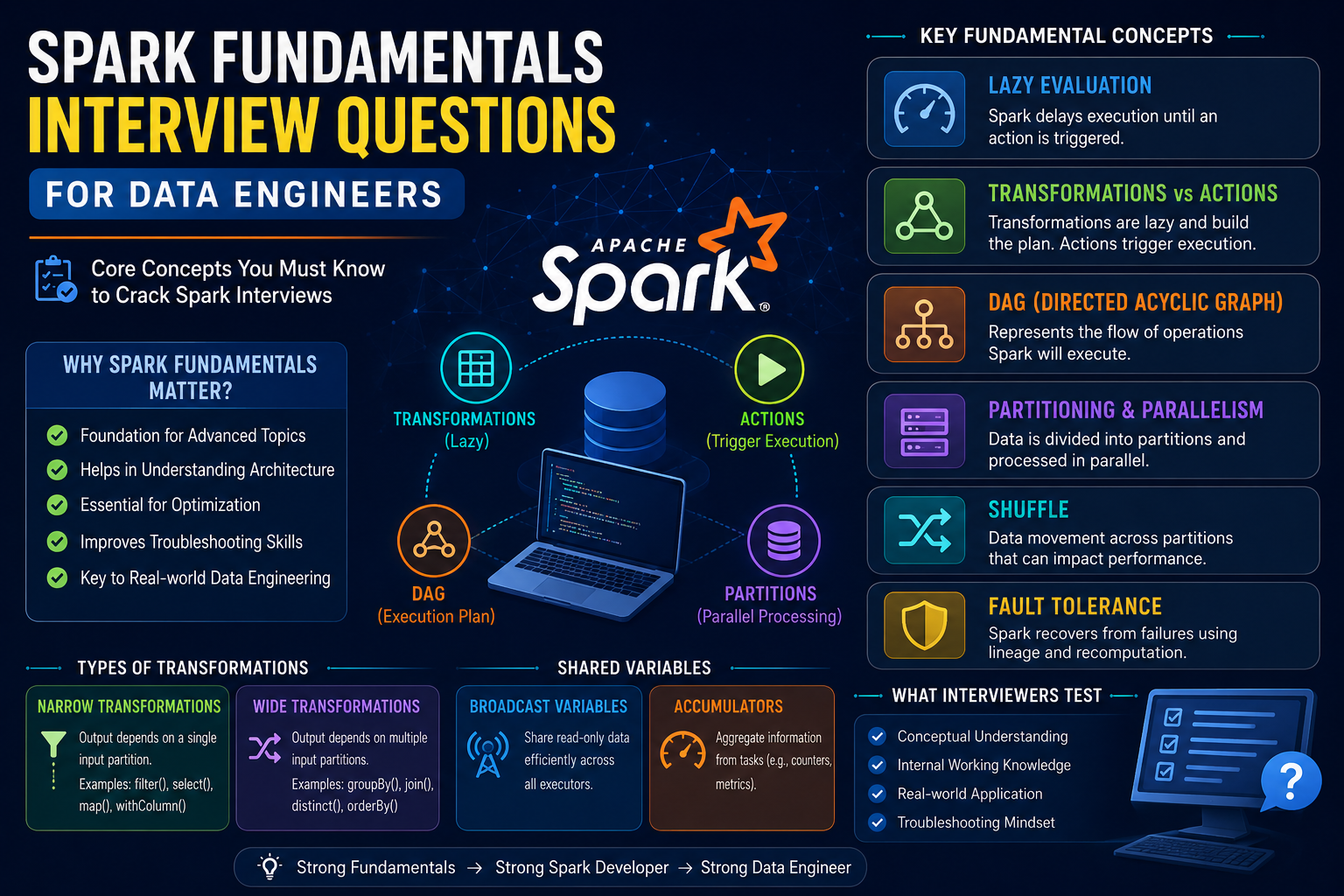
Fundamentals
This area focuses on core Spark concepts.
Interviewers want to know whether you understand:
- Spark basics
- Transformations
- Actions
- Lazy Evaluation
- DAG
- Partitioning
- Shuffle
Strong fundamentals make advanced topics much easier.
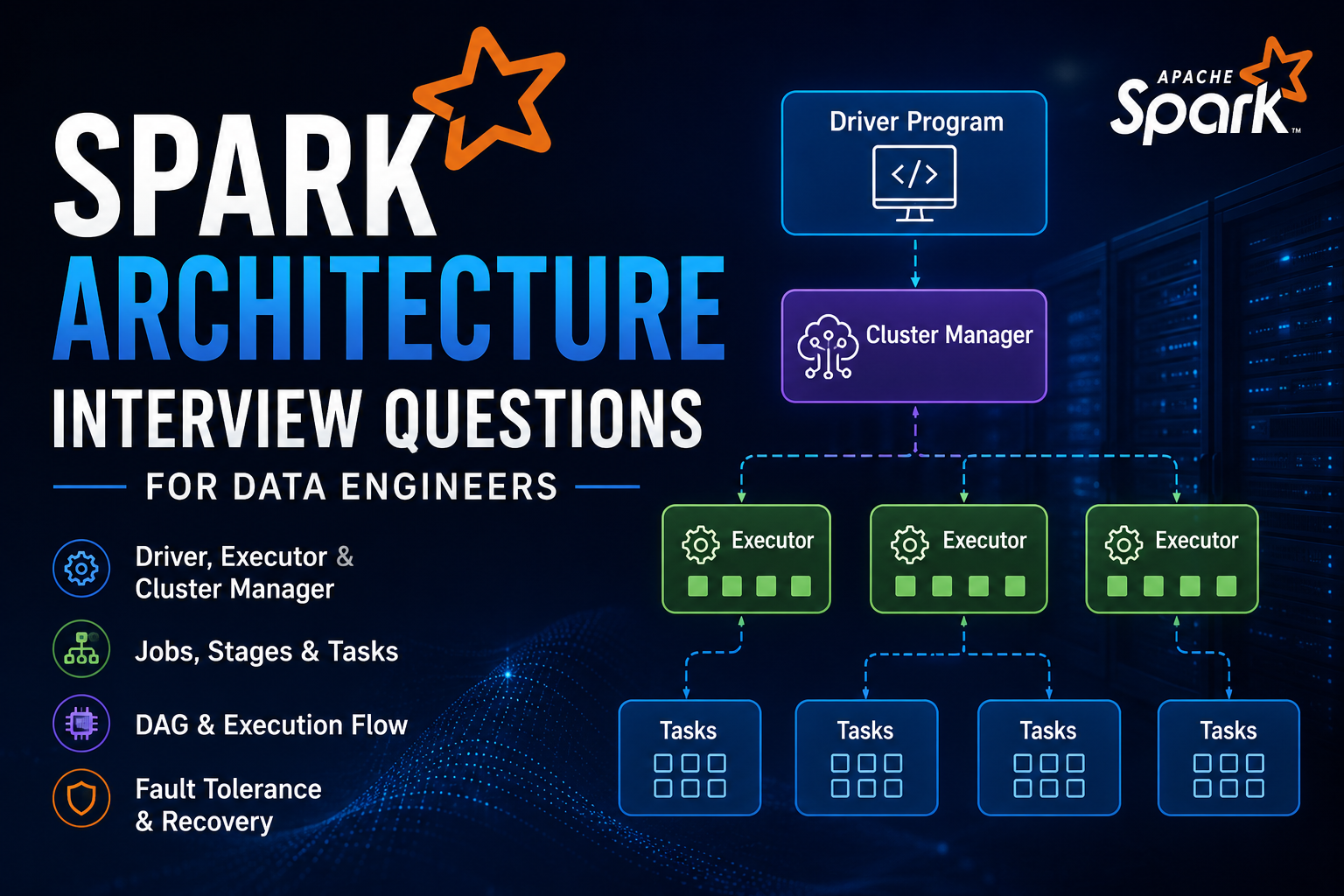
Architecture
Architecture questions evaluate whether you understand how Spark works internally.
Topics commonly covered include:
- Driver
- Executors
- Cluster Manager
- Jobs
- Stages
- Tasks
- Fault Tolerance
Many interviewers spend significant time in this area because architecture knowledge reveals how deeply a candidate understands Spark.
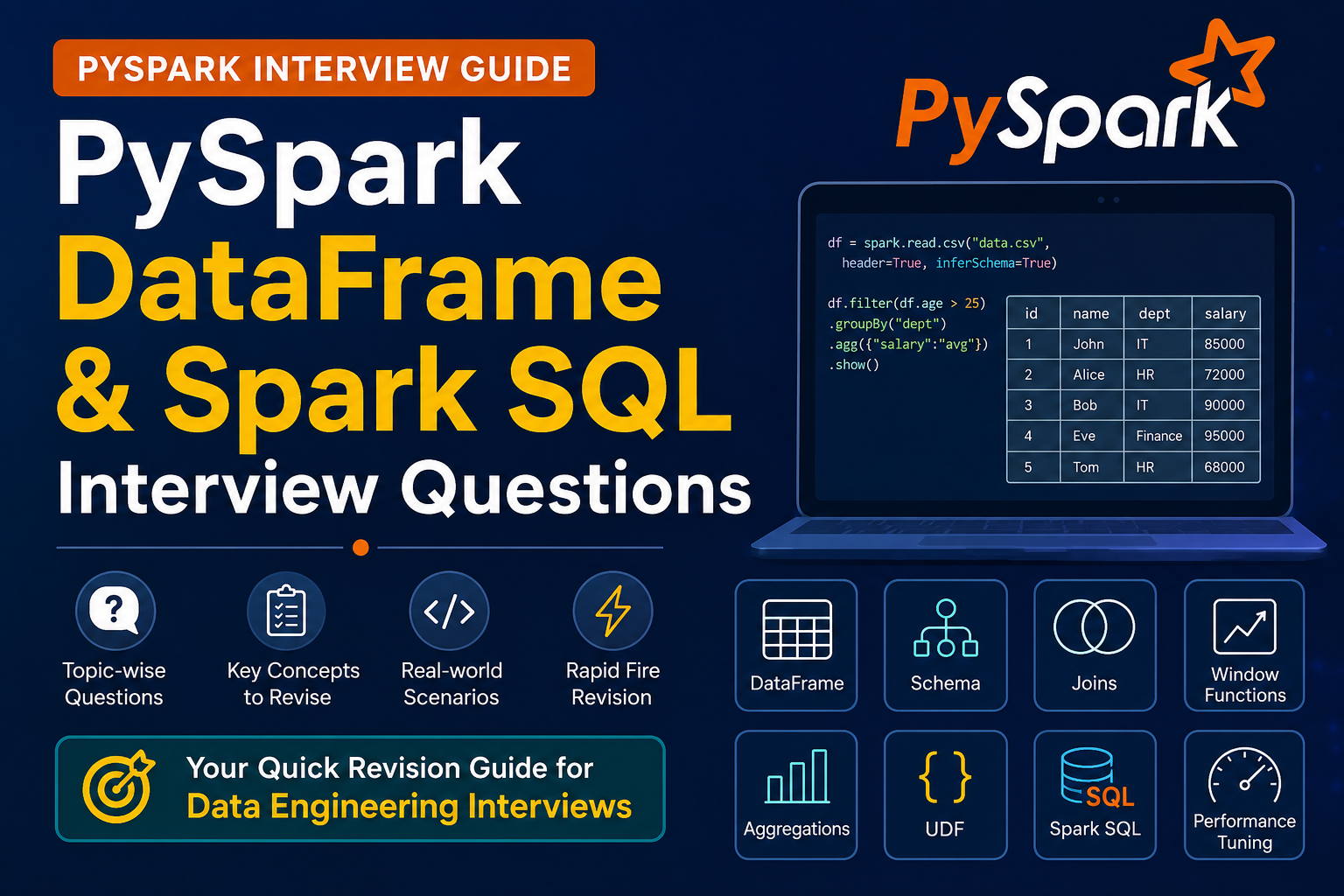
Data Processing
This area focuses on hands-on PySpark development.
Topics include:
- DataFrames
- Spark SQL
- Window Functions
- UDFs
- JSON Processing
- Schema Handling
These questions help interviewers assess practical experience.
Performance Optimization
This area becomes increasingly important for experienced engineers.
Topics include:
- Broadcast Joins
- Shuffle Optimization
- Data Skew
- AQE
- Partitioning
- Spark UI Analysis
Optimization questions separate production engineers from candidates who only know Spark syntax.
Production Experience
Senior-level interviews frequently focus on:
- Troubleshooting
- Monitoring
- Data Quality
- Cost Optimization
- Reliability
- Scalability
At this level, interviewers are evaluating engineering judgment rather than definitions.
Common Mistakes Candidates Make While Preparing Spark
Over the years, several preparation mistakes appear repeatedly.
Memorizing Answers
Many candidates memorize interview answers without understanding the concepts.
This approach usually fails when interviewers ask follow-up questions.
Ignoring Architecture
Architecture is often underestimated.
However, many advanced Spark discussions are impossible to answer without understanding Drivers, Executors, Jobs, Stages, and Tasks.
Skipping Spark UI
Spark UI is one of the most important tools for debugging and optimization.
Unfortunately, many candidates have never used it.
Avoiding Optimization Topics
Concepts such as Shuffle, Data Skew, AQE, and Broadcast Joins are heavily discussed in interviews.
Ignoring optimization topics creates a major gap.
Learning Only Through Coding
Coding is important, but interviews also evaluate reasoning, architecture understanding, and troubleshooting approaches.
Spark Interview Preparation Framework
The most effective way to prepare Spark is through a phased approach.
Spark Fundamentals
        ↓
Spark Architecture
        ↓
DataFrames & Spark SQL
        ↓
Join Concepts
        ↓
Performance Optimization
        ↓
Production Scenarios
        ↓
System Design & Architecture
Each phase builds upon the previous one.
Skipping a phase often creates knowledge gaps that become visible during interviews.
Phase 1: Spark Fundamentals
Spark Fundamentals form the foundation of every Spark interview.
Before learning optimization or architecture, you should understand how Spark processes data.
Focus on:
- Apache Spark Overview
- PySpark Basics
- SparkSession
- SparkContext
- Transformations
- Actions
- Lazy Evaluation
- DAG
- Lineage
- Fault Tolerance
- Partitioning
- Shuffle
- Narrow Transformations
- Wide Transformations
Why This Phase Matters
Most Spark interview questions ultimately connect back to fundamentals.
Without strong fundamentals, optimization and architecture topics become difficult to understand.
Common Interview Topics
- What is Spark?
- Why Spark over Hadoop?
- What is DAG?
- What is Lazy Evaluation?
- What is Shuffle?
- What is Partitioning?
Phase 2: Spark Architecture
Once fundamentals are clear, the next step is Spark Architecture.
This is where you learn how Spark works internally.
Focus on:
- Driver
- Executors
- Worker Nodes
- Cluster Manager
- Job
- Stage
- Task
- DAG Scheduler
- Task Scheduler
- Resource Allocation
- Fault Recovery
- Speculative Execution
Why This Phase Matters
Many advanced interview questions are actually architecture questions disguised as optimization questions.
A strong architecture foundation helps answer them confidently.
Common Interview Topics
- Explain Spark Architecture
- Driver vs Executor
- Job vs Stage vs Task
- What happens when an executor fails?
- How does Spark achieve fault tolerance?
Phase 3: PySpark DataFrame and Spark SQL
Most modern Spark development happens through DataFrames.
This is one of the most frequently tested interview areas.
Focus on:
- DataFrames
- Spark SQL
- Window Functions
- UDFs
- Pandas UDFs
- JSON Processing
- Schema Handling
- Schema Evolution
- Schema Drift
- Delta Lake Basics
- Apache Iceberg Basics
Why This Phase Matters
This phase represents practical Spark development and is heavily used in real-world projects.
Common Interview Topics
- RDD vs DataFrame
- Catalyst Optimizer
- Tungsten Engine
- Window Functions
- Schema Handling
Phase 4: Spark Join Concepts
Joins are among the most important Spark interview topics.
Focus on:
- Broadcast Join
- Sort Merge Join
- Shuffle Hash Join
- Cross Join
- Join Skew
- Join Optimization
- Execution Plans
Why This Phase Matters
Many Spark performance issues originate from joins.
Understanding join strategies is essential for optimization discussions.
Common Interview Topics
- Broadcast Join
- Join Optimization
- Join Skew
- Shuffle During Joins
Phase 5: Spark Performance Optimization
This phase is where many interviews become challenging.
Focus on:
- Shuffle Optimization
- Cache vs Persist
- AQE
- Data Skew
- Salting
- Predicate Pushdown
- Partition Pruning
- Spark UI
- Small Files Problem
- Memory Tuning
Why This Phase Matters
Optimization questions help interviewers assess real production experience.
Common Interview Topics
- What causes Shuffle?
- How do you reduce Shuffle?
- What is Data Skew?
- How do you optimize Spark jobs?
Phase 6: Real World Spark Scenarios
Modern interviews increasingly focus on practical scenarios.
Instead of definitions, interviewers evaluate problem-solving ability.
Focus on:
- Extra Columns in Source Files
- Missing Columns
- Schema Drift
- Duplicate Records
- Incremental Loads
- CDC Processing
- OutOfMemoryException
- SLA Failures
- Streaming Lag
- Retry Mechanisms
Why This Phase Matters
This phase reflects real-world Data Engineering work.
Common Interview Topics
- Job suddenly became slow
- Pipeline failed after schema change
- Duplicate records appeared
- Streaming pipeline started lagging
Phase 7: Spark System Design and Architecture
This is the final phase of preparation.
Focus on:
- Bronze Silver Gold Architecture
- Delta Lake Architecture
- Iceberg Architecture
- Monitoring Frameworks
- Retry Frameworks
- Cost Optimization
- Data Quality
- Disaster Recovery
- Batch and Streaming Integration
Why This Phase Matters
Senior-level interviews increasingly focus on architecture and design decisions.
Common Interview Topics
- Design a Spark pipeline processing TB-scale data
- Design monitoring and recovery framework
- Optimize cloud cost for Spark workloads
Experience Based Preparation Plan
Freshers (0–1 Year)
Focus primarily on:
- Fundamentals
- DataFrames
- Spark SQL
- Basic Architecture
Intermediate Engineers (1–4 Years)
Focus on:
- Architecture
- Joins
- Optimization
- Spark UI
- Production Scenarios
Senior Engineers (5+ Years)
Focus on:
- System Design
- Cost Optimization
- Reliability
- Monitoring
- Scalability
- Architecture Decisions
As experience increases, preparation naturally shifts from syntax to decision-making.
Recommended Learning Path
A practical preparation approach can look like this:
Week 1–2
Spark Fundamentals
Week 3
Spark Architecture
Week 4
DataFrames and Spark SQL
Week 5
Join Concepts
Week 6
Performance Optimization
Week 7
Production Scenarios
Week 8
System Design and Architecture
Following a structured path prevents information overload and improves retention.
Spark Interview Preparation Series
This roadmap is the first article in the Spark Interview Preparation Series.
The upcoming articles will cover each phase in detail.
- Spark Fundamentals Interview Questions for Data Engineers
- Spark Architecture Interview Questions Explained
- PySpark DataFrame and Spark SQL Interview Questions
- Spark Join Interview Questions and Optimization Techniques
- Spark Performance Optimization Interview Questions
- Real World Spark Scenario-Based Interview Questions
- Spark Architecture and System Design Interview Questions
By the end of this series, you will have a structured preparation strategy for beginner, intermediate, advanced, and architecture-level Spark interviews.